Future AGI observability for ADK
Future AGI is an observability and evaluation platform
for AI agents. The
traceai-google-adk package
auto-instruments ADK agents and exports every agent run, model call, tool
execution, and event-loop cycle to Future AGI as OpenTelemetry spans, where you
can inspect the run tree, evaluate behavior, and run experiments.
Overview
The traceai-google-adk package adds OpenTelemetry instrumentation for ADK,
allowing you to:
- Trace agent runs: Capture every agent invocation, tool call, model request, and response with prompts, completions, parameters, and token usage.
- Evaluate behavior: Run pre-built or custom evaluators against the captured traces.
- Debug agents: Drill into hierarchical run trees to find failed tool calls, latency hotspots, and unexpected branches.
Prerequisites
- Sign up at app.futureagi.com.
- Copy your
FI_API_KEYandFI_SECRET_KEYfrom the dashboard. - Set the environment variables:
export FI_API_KEY=<your-fi-api-key>
export FI_SECRET_KEY=<your-fi-secret-key>
export GOOGLE_API_KEY=<your-google-api-key>
Installation
The traceai-google-adk package declares google-adk and google-genai as
runtime dependencies, so they install transitively.
Sending Traces to Future AGI
Register the Future AGI tracer once at startup and attach the
GoogleADKInstrumentor before running any agent. Every subsequent ADK agent
invocation is captured automatically.
import asyncio

from fi_instrumentation import register
from fi_instrumentation.fi_types import ProjectType
from google.adk.agents import Agent
from google.adk.runners import InMemoryRunner
from google.genai import types
from traceai_google_adk import GoogleADKInstrumentor

tracer_provider = register(
    project_type=ProjectType.OBSERVE,
    project_name="adk-weather-agent",
)
GoogleADKInstrumentor().instrument(tracer_provider=tracer_provider)


def get_weather(city: str) -> dict:
    """Retrieves the current weather report for a specified city."""
    if city.lower() == "new york":
        return {
            "status": "success",
            "report": "The weather in New York is sunny with a temperature of 25°C.",
        }
    return {
        "status": "error",
        "error_message": f"Weather information for '{city}' is not available.",
    }


agent = Agent(
    name="weather_agent",
    model="gemini-flash-latest",
    description="Agent to answer weather questions.",
    instruction="You must use the available tools to find an answer.",
    tools=[get_weather],
)


async def main():
    runner = InMemoryRunner(agent=agent, app_name="weather_app")
    await runner.session_service.create_session(
        app_name="weather_app", user_id="user", session_id="session"
    )
    async for event in runner.run_async(
        user_id="user",
        session_id="session",
        new_message=types.Content(
            role="user",
            parts=[types.Part(text="What is the weather in New York?")],
        ),
    ):
        if event.is_final_response():
            print(event.content.parts[0].text.strip())


if __name__ == "__main__":
    asyncio.run(main())
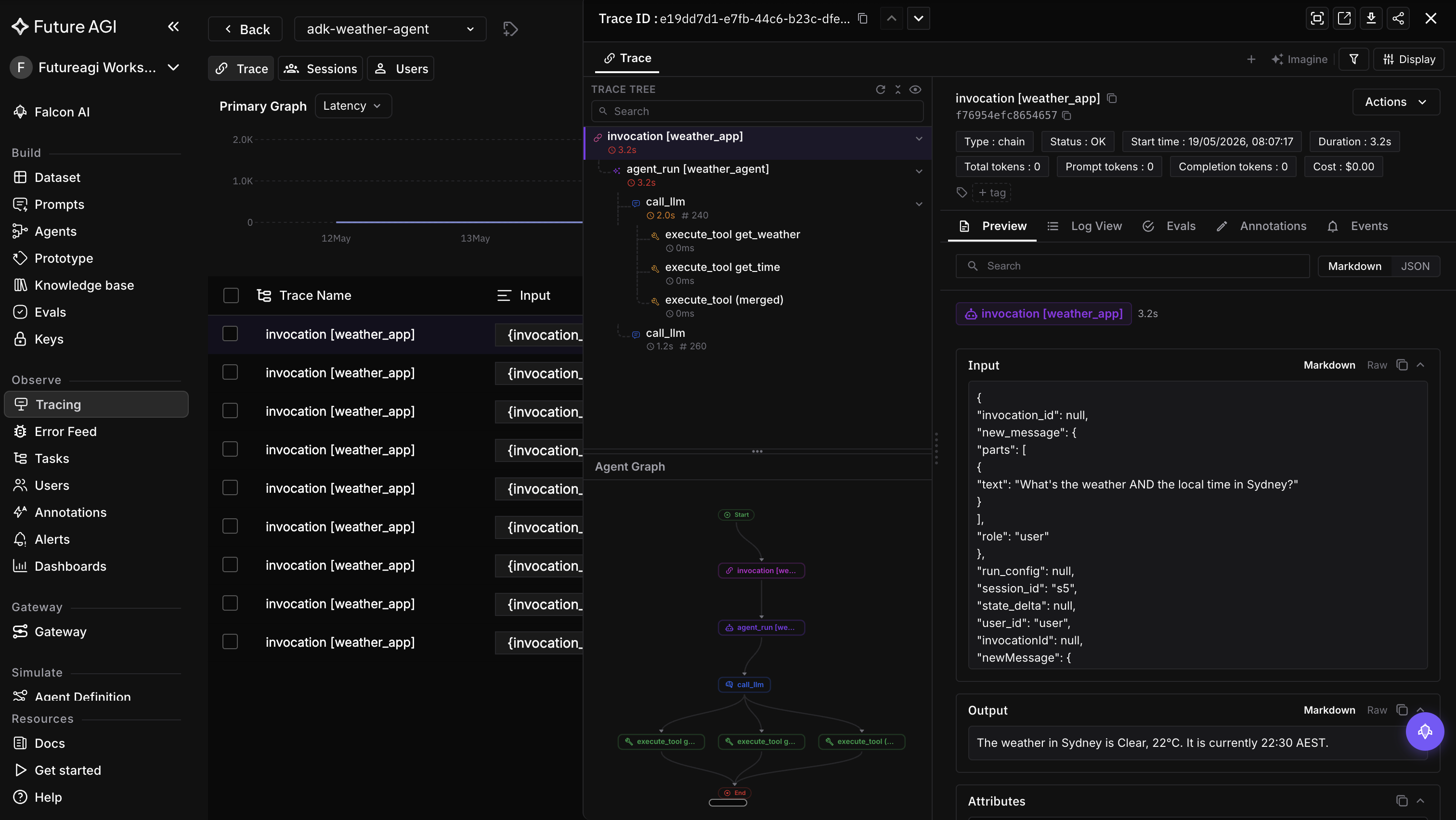
View Traces in the Dashboard
Run the agent, then open your project in the Future AGI dashboard. Each ADK agent run produces a hierarchical trace with prompts, completions, model parameters, token usage, tool inputs and outputs, and event-loop cycles laid out for inspection.